There were a few incidents during my college career that were truly learning experiences where the lesson went well beyond engineering. They stand out as lessons for business and lessons for life.
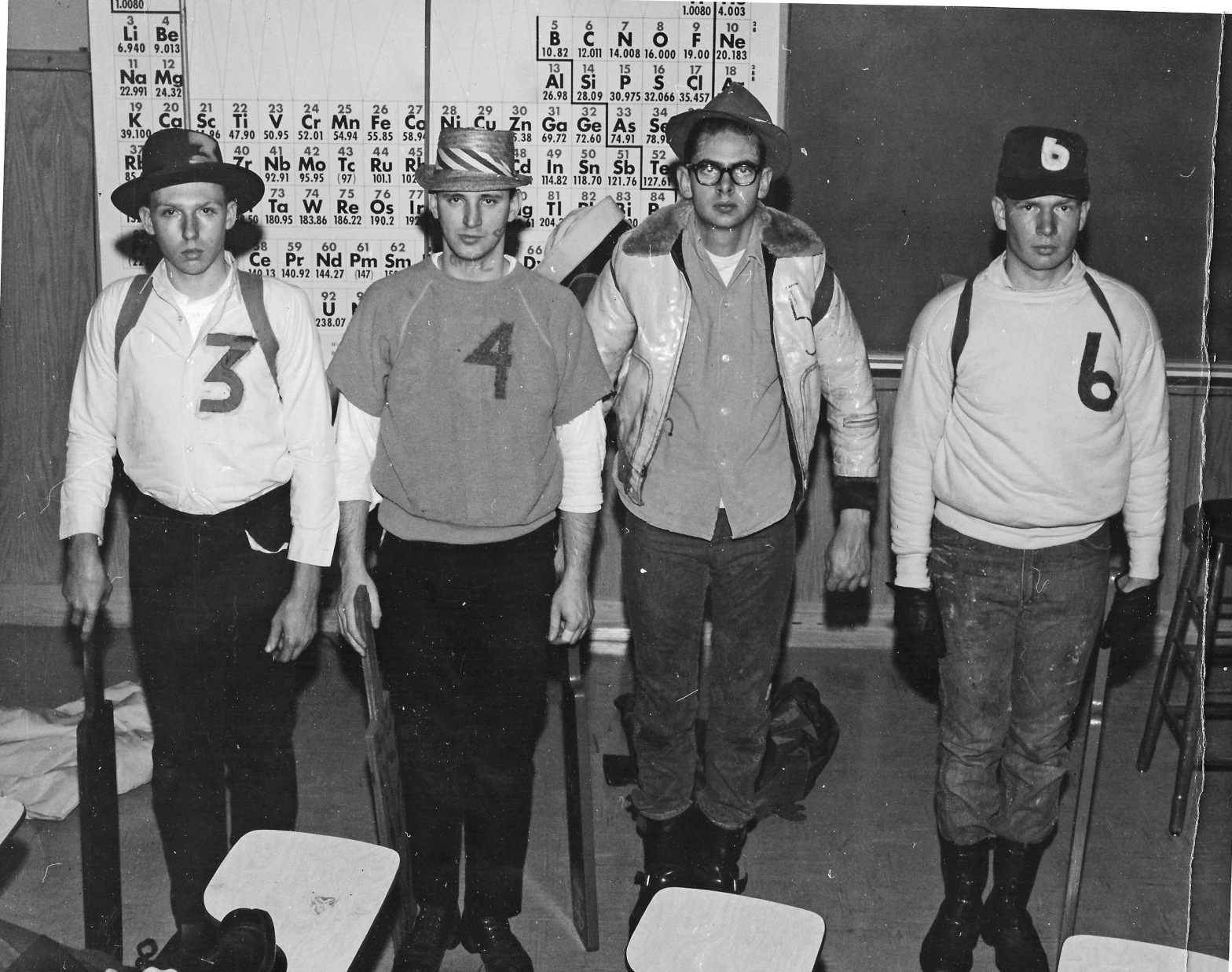
The picture above is of my friend, Dennis Connell and I during our initiation into the fraternity, Iota Xi Omega at Union College. I am #5 and Dennis is #6.
A Man Has Got To Know His Limitations
One of my classmates, Stanley Scarrano was a good student, but he was a perpetual whiner. We took a class together with Dr. Wang, a Chinese professor and following every test Stan would approach him to argue for a higher grade. He would already have a pretty good grade but would always argue for extra points.
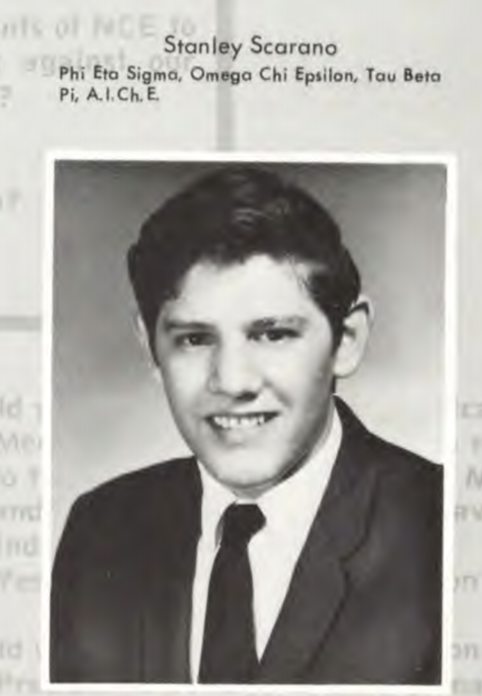
I remember a particular incident where Stan got a 90% on the test but as usual he wasn’t satisfied. There was one problem worth 10 points marked completely wrong. Stan approached Dr. Wang and argued that although he got the wrong numerical answer he had the method right and insisted that he be given full credit for the problem. Dr. Wang responded in broken English, “No, you get wong answer, you lose 10 point, that’s all.” Stan was incessant and wouldn’t let it go, so Dr. Wang took the test paper back and gave him half credit for the correct method, five points. But he didn’t return the paper. He sat down and on the spot re-graded the entire test deducting one point here, two points there and so on until the total was minus ten points. He then handed the test back. This drove Stan crazy and he again started to argue even more vigorously. Dr. Wang calmly told him “No, no, no you no understand, I hold all cards.”
In every negotiation in business and life one has to understand who holds the cards. Bluffing and bullshitting will only get you so far. Years later in the business world I heard this phrased another way, “The Golden Rule is he who has the gold rules.”
Wizard of the Weird Circular Slide Rule
There were a lot of bright students in the Chemical Engineering program but Don Winters was indisputably the brightest student I ever met. He was my classmate in several courses including one of the most challenging courses required for ChE’s. The course was Transport Phenomena. It involved complex calculations of mass and energy flow notorious for its level of difficulty. Many worthy students flunked this course.
The textbook was titled Transport Phenomena by Bird, Stewart and Lightfoot. The subject matter was esoteric, the math was difficult and the authors were consummate tricksters. The first clue was in the preface where they outlined their objectives in writing the text. If you take the first letter of each sentence in the preface it spells out, “This Book Is Dedicated to O. A. Hougen”. Hougen was the author of a previously published seminal text entitled Chemical Process Principles.
Their diabolical word play continues throughout the book interspersed with abundant differential equations and advanced mathematical concepts describing fluid flow, heat transfer, and molecular diffusion. The exams were open book and graded on a curve. That is, they were graded as a competition among the students. No one ever got a 100%. The material was extremely difficult and time was limited. As a result, the open book approach deceived many good students. They assumed since they could freely look stuff up during the exam they didn’t have to study that hard. They were dead wrong! There was a one hour limit and problems were carefully chosen so that even if you knew exactly what you were doing it was nearly impossible to finish in the allotted time.
To compensate grades were awarded on a curve where the highest score got an A, the next highest a B and so forth. Typically, when the tests were handed back the highest would usually be about 60% and perhaps occasionally a 75% or 80% and they would then quickly decline to 0%. Some felt it wasn’t fair but in reality, it is a perfectly accurate reflection of the “real world” outside of academia.
If you studied the material well it was always amusing during an exam. While working out solutions to the problems you could hear some of the student’s frantically paging through their books looking for a clue. You knew they hadn’t studied the material and were in a complete panic. You also knew the more they flipped through the pages the more confused they became. They were rapidly entering the “circle of doom” where the mind just goes completely blank.
Don Winters was the extreme introvert. He never participated in class, just sat quietly in the last seat in back of the room and only spoke when called upon. And then, in very succinct phrases, providing only the bare minimum of information required to answer the question, no more, no less. He never volunteered, never pontificated.
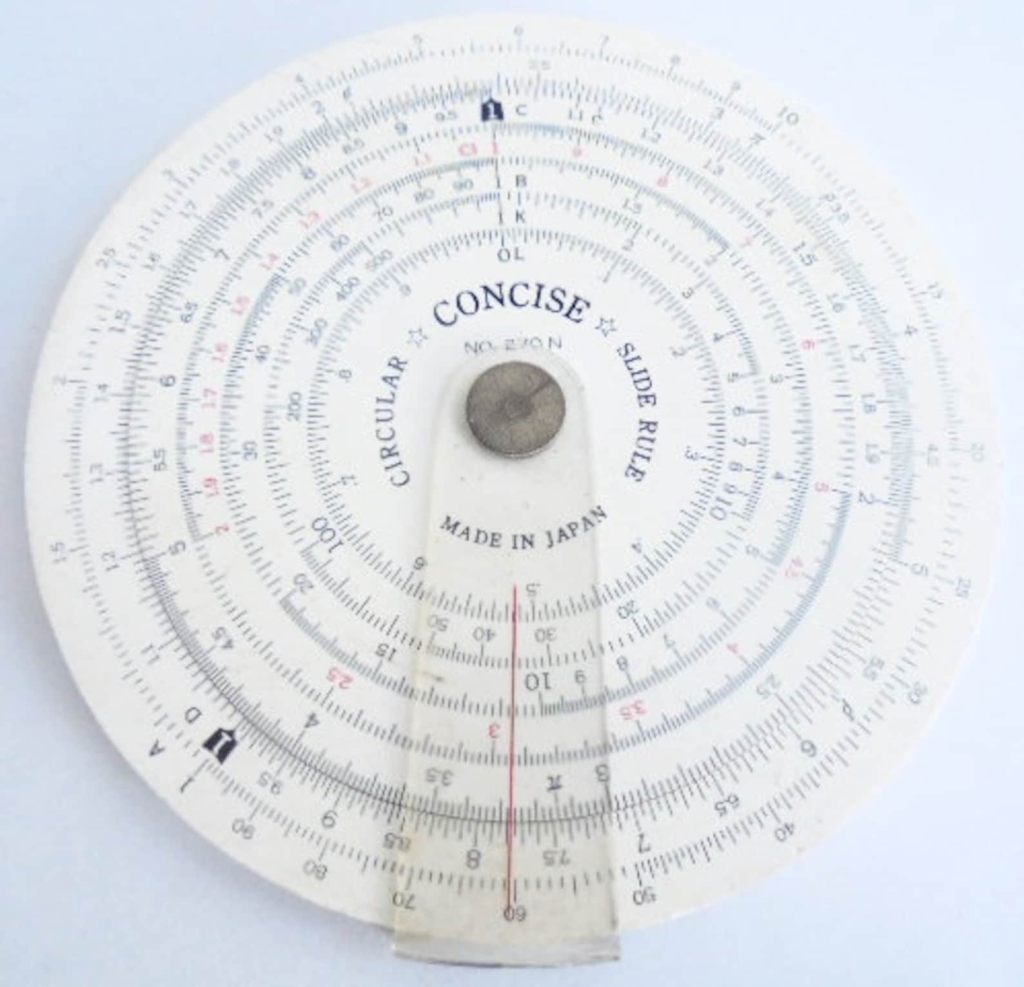
When I took this class, it was well before the advent of electronic calculators and we all had slide rules to carry out our numerical calculations. The standard for nearly everyone was a ten inch K&E Deci-Lon carried in a leather case that hung from your belt. Slide rules came in five inch and ten inch. The bigger the slide rule the more accurate it was and the engineer’s standard was the ten inch K&E. Don didn’t have a ten inch K&E. He didn’t even have a five inch K&E. He had a weird circular slide rule about 3 inches in diameter and was the only student that had one like that. However, it didn’t seem to handicap him.

Following the first exam, test papers were handed out with the highest grade first followed by the descending grades. The order went something like; Winters 100%, Joe Blow 60%, Jane Doe 50% and so on down to 0%. The pattern was repeated on subsequent exams throughout the semester. About half way through it was obvious the professor was having a problem with Don Winters; didn’t appreciate his nonchalant attitude coupled with his complete mastery of the material. The professor would go out of his way to call on him and would always get the same concise but consistently correct answers from Don.
As the semester progressed we would often be called at random to present our homework at the blackboard. The solutions would usually occupy at least three of the four blackboards. They consisted of one esoteric equation after the next followed by numerical calculations to arrive at a final answer. On one instance when one of our fellow students performed this task at the board the professor announced the student’s answer was incorrect. He then erased the students work and replaced it with three blackboards of his own calculations. Winters raised his hand and when called on by the Prof he replied, “that’s not what I got”. The professor was visibly annoyed and instructed Don to go to the board and show his calculations, with the terse admonition, “OK, let’s see what you got”.
When Don stood at the board and opened his text book you could hear the binder crack as though it was the first time it was ever opened. On a single board, he summarized his calculations and sat down. He had a different numerical answer than the professor. OK, now this was war! The professor then went through his own calculations step by step to demonstrate where Winters had gone awry. Somewhere into the third blackboard the Prof abruptly stopped in his tracks. There was complete silence. Even if you didn’t follow the mathematics everyone instinctively knew what just happened. The Prof had discovered his own mistake! Finally, after several long minutes he turned to the class and said, “Winters’ was correct. Class dismissed”. He never called on Winters again and Don Winter’s continued to get 100% on all the exams. Very impressive.
In the last semester of senior year I showed up for our final Chem Engineering class taught by a Professor notorious for his difficult exams. He started to take roll call, “Hernandez, Stenseler, Scarrano, Gunardson, Gymkowski” and then stopped abruptly and fell silent. He turned to the class and asked, “Where’s Winters, Don Winters was one of you guys, where is he?” Silence for another minute or so. Then one of our guys spoke up, “He’s gone, Winters dropped out last semester”. The Professor was shocked. He asked, “Why did he drop out?” No one answered. He then said. “I’ve been teaching for eighteen years and I’m infamous for my exams in the Chem E 27 course (First year introductory chemical engineering calculations course required of all Chem E’s). “In eighteen years of teaching nobody has ever obtained 100% on one of my Chem E 27 exams, with the sole exception of Don Winters who showed up late, left early and got 100%”. He asked again, to no one in particular, “Why did he drop out?” Nobody answered. I never knew the answer either, after all it was 1969 and maybe he went to Woodstock that summer or something and never recovered. Who knows?
After I graduated and went to work for CE Lummus I discovered Don Winters was working as a technician in the research lab. I renewed my acquaintance with him and a year later he returned to NCE and finished his Bachelor’s degree. I lost touch with him after that and have no idea where he finally wound up. He was probably the brightest guy I ever met, but definitely a free spirit.
The story I’ve relayed about Winters reminds me of one of my favorite tales about Richard Feynman. Niels Bohr, a Nobel Prize winner himself, was once asked what he thought of Richard Feynman. He replied “There are two kinds of geniuses in the world, the ordinary genius and the extraordinary genius. An ordinary genus is someone you and I could be like if we were very much smarter than we are. But an extraordinary genius is someone who thinks in an entirely different way. Richard Feynman is an extraordinary genus.” To me, Winters may have well been in that category.
Nandy Hernandez – The Cuban refugee
Another of my classmates, Fernando (Nandy) Hernandez was also a very bright guy. He was one of the group of guys that hung out together during my student days at NCE. Nandy was a Cuban refugee who escaped during the revolution when Castro took power. He escaped aboard one of the so called “banana boats” that made it the ninety miles from Cuba to Florida in the early days of the Cuban revolution. He was a low key guy and an excellent student despite his limited English. We took many of the same classes together, were a little older than most of the other students, both of us were married and somehow naturally gravitated to each other.
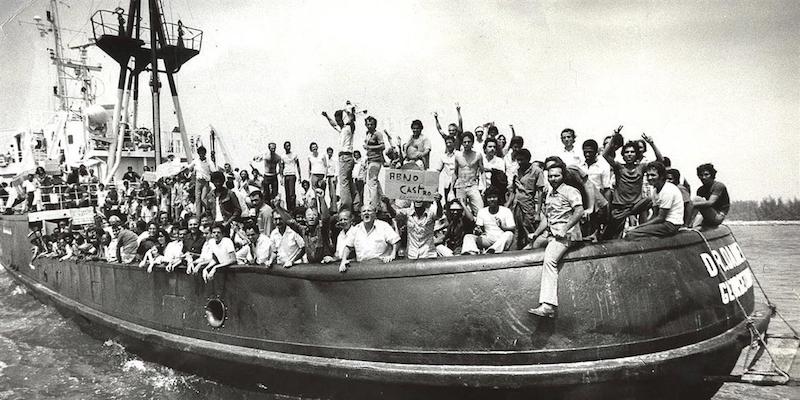
After getting to know him I learned he escaped from Cuba under dire circumstances and he and his wife eventually made their way to Miami and then to Newark, NJ. He enrolled in the Chemical Engineering program at NCE and was doing well but really aspired to become a medical doctor like his father. NCE is a NJ state school, so tuition for in-state students is very reasonable and since he couldn’t afford the tuition at medical school, chemical engineering was his next best alternative.
I eventually learned during the revolution his father was politically active in opposing the Castro regime. Even though he was a highly respected medical doctor, he was imprisoned by Castro for his political views. I also learned that Nandy was working full time at a low paying job to pay his rent, daily living expenses and tuition and at the same time trying to put enough money aside to get his father out of Cuba and to the USA. Getting his father out of prison and to the US involved paying bribes in Cuba, ransom if you will. Enough to get him out of prison and passage on one of the illegal dilapidated boats bound for Miami. It took Nandy several years to save enough working at menial jobs while going to night school.
Eventually, after we finally graduated, he had enough funds and advanced his plan for his father’s escape through a Florida based Cuban underground organization. His father eventually arrived up north in West Orange, NJ, a town not far from Newark and shared an apartment with Nandy and his wife.
Even though his father was a qualified medical doctor he couldn’t get a medical license or practice medicine in the US. So, he got a job as an orderly in a hospital in West Orange cleaning bed pans until he learned enough English and was confident enough to take the required medical exam for his license to practice in the US. It took several years but eventually he got his medical license, established his private practice and started making a substantial income. By this time, Nandy graduated from NCE and was working at CE Lummus as a junior process engineer. We worked together for a short time in Bloomfield, NJ, at the company headquarters.
Nandy still had the ambition to become a medical doctor and now that his father could afford to help him with tuition and miscellaneous expenses he applied and was accepted in medical school, to the best of my recollection, in Barbados. He attended the University there and when he completed his studies secured an internship at the Miami Medical Center in Florida. We kept in touch for a few years and the last I heard from him he was the chief surgeon at the Miami Medical Center ER. I’m disappointed I lost touch with he and his wife. He was an inspiration to me at a crucial time. Every once in a while, when my motivation would start to fade I would consider what Nandy was up against and realize I didn’t have it so tough after all. It always would re-energize my determination.
A Failure to Communicate
I had a professor for thermodynamics, Dr. Chen, who had a pretty thick Chinese accent. You had to listen very carefully during his lectures to follow him. I really don’t know how the non-native speakers in the class could understand him at all, but somehow, they did. There was a Cuban refugee in the class, Carlos, who spoke with a very heavy Spanish accent. Conversations between Carlos and Dr. Chen were quite a challenge to follow. In one particular session, we were learning a about a classic thermodynamic equation known as the van der Waals equation. The van der Waals equation (or van der Waals equation of state) is a mathematical expression relating the density of gases and liquids (fluids) to pressure (p), volume (V), and temperature (T).
Dr. Chen was lecturing, and with his accent and inability to pronounce the letter V which always came out sounding like a W, he kept repeating “You use WanderWall equation and then you substitute walues for …………” Carlos kept looking at the Professor with a quizzical expression and finally raised his hand. He asked, “what dis mean Wanderwall equation, what dis mean?” Professor Chen responded, “What you mean, what dis mean – dis is it, Wanderwall equation”.
“What we’ve got here is a failure to communicate.” ….Paul Newman in Cool Hand Luke
Somehow the Cuban guy passed the course but I’ll never know how. Take home messages for me were – never underestimate someone’s ability because of difficulty with language and yes, mathematics is in fact a truly universal language.
Unit Ops Lab – Clean Up in Aisle Five
Ray Cutro was a helluva nice guy. Not the brightest guy in the class but a real nice guy; really easy to get along with. In the class called Unit Ops Lab, students were asked to form groups of four or five individuals to do a semester long project of their own choosing. When we were asked to form our group, four of us that had been going through together immediately coalesced and started to discuss what we would do for our project. Ray wasn’t asked to join any of the other groups and he eventually approached sheepishly and asked me, “Hey, guys could I be in your group?” I wasn’t crazy about the idea but invited Ray to join us anyway. The reason I wasn’t enthusiastic was that even though it would mean an additional member for the group, I knew I would have to assign one of our guys to keep an eye on Ray.
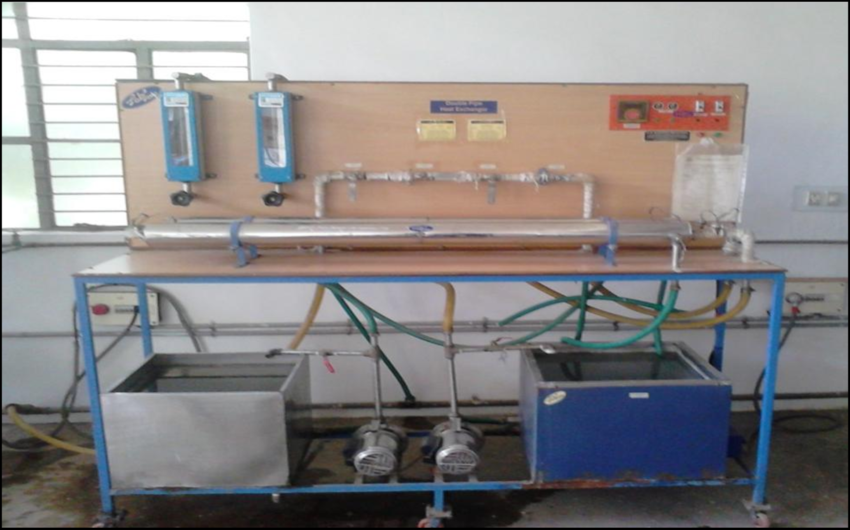
For our project, we decided to build a double pipe heat exchanger and a setup to monitor heat transfer performance for various flow rates through the equipment. When completed the heat exchanger was about ten feet long and about eight feet high and looked very much like this.
Double Pipe Heat Exchanger
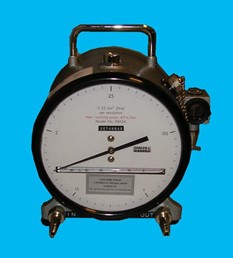
We piped up water to the inner pipe and compressed air to the outer pipe to measure the heat transfer from cold water to warm air. To determine flow rate of air, we used a wet gas meter on the air side outlet. The wet gas meter looked like a large alarm clock. It was about eighteen inches in diameter and for safety was constructed so that in case of overpressure the back would blow out. Outlet valves were located on the water side at ground level and on the air side at the top of the exchanger. We had a step ladder set up at the outlet of the exchanger so that we could reach the outlet air valve. One guy was stationed at the water valve at ground level and another at the air valve on the step ladder. I was stationed at the wet gas meter and took readings of the flow rate for several increments of flow.
Wet Gas Meter
All went well, at first. We started at low flow rates and then recorded temperatures and flow rates at several intervals as we slowly increased the air flow rate. Ray was stationed on the step ladder in control of the air flow through the exchanger. As we increased the air flow to higher levels the sound became progressively louder and louder. At one point, it became so loud that I had a hard time communicating with Ray at the top of the ladder. The needle on the wet gas meter started to spin faster and faster and the meter itself started to pulsate. I got concerned we were pushing it too far and shouted to Ray to cut back on the flow of compressed air. He misunderstood and instead opened the air valve wide open. The wet gas meter expanded and contracted once or twice and then the back blew out as it was designed to do and the internal parts flew across the lab to the opposite side of the room.
One of our classmates, Sue Chein, had assembled a large glass distillation column on that side of the lab for her experiment. The guts of our wet gas meter took out the center section of her glass column. Fortunately, she had completed her experiment and was no longer standing near her apparatus. It was quite the mess.
Humanities – English Literature
The engineering curriculum at Newark College of Engineering was steeped in math, physics and chemistry but the curriculum also required elective courses in the humanities. There were several options including history, literature, art and music. I always enjoyed reading and so naturally was attracted to English literature for my required humanities courses. I took all of my electives in English Literature and accumulated enough credits to meet the requirements for a major in chemical engineering and a minor in English Literature.
The course involved reading assigned titles followed by expository writing on each literary work. Many of the titles in the first literature courses were classics I had previously read so they didn’t interfere with the time required for study of my core technical subjects. Later, I was required to read other more advanced works that I was unfamiliar with, but enjoyed immensely. It was a welcome respite from the heavy duty technical courses.
Today, I frequently take these short quizzes featured on Facebook to more or less keep my mind active. One category is the “How Many Have You Read?” quiz. Unsurprisingly, I always score in the top 5% or 10%. Many of the titles in these quizzes are Classics by Alexander Dumas, Joseph Conrad, Mark Twain, Hemingway and his arch rival Faulkner, and others by John Steinbeck, Albert Camus, and Dostoevsky. These still are my favorites.
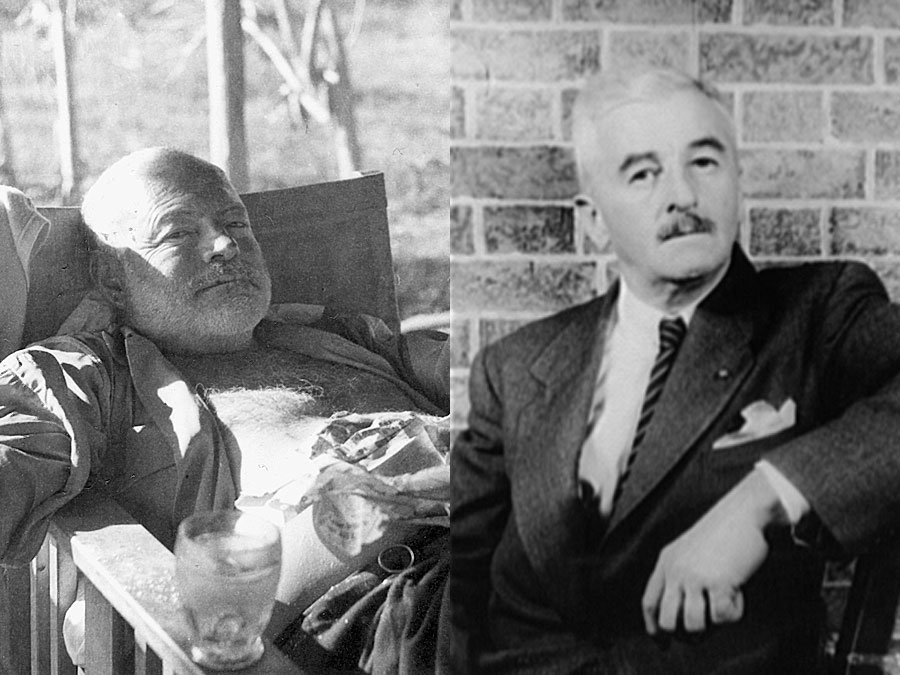
Hemingway and Faulkner were contemporaries and rivals. I think that was more of a problem with Ernest Hemingway than William Faulkner. There is an interesting contrast between the two though. Whereas Hemingway was a world traveler and raconteur, Faulkner lived and wrote all his works within a few miles of where he was born and raised in rural Mississippi. Hemingway once commented on Faulkner saying, “My fish is the giant blue marlin, Faulkner’s is the lowly catfish.” That may have been, but Faulkner wrote some very powerful stuff and was awarded the Nobel Prize in Literature in 1949. Not too shabby for a guy that never left rural Mississippi! Hemingway finally got his Nobel Prize in Literature five years later in 1954. But Faulkner beat him to the punch.
Graduation – 1971
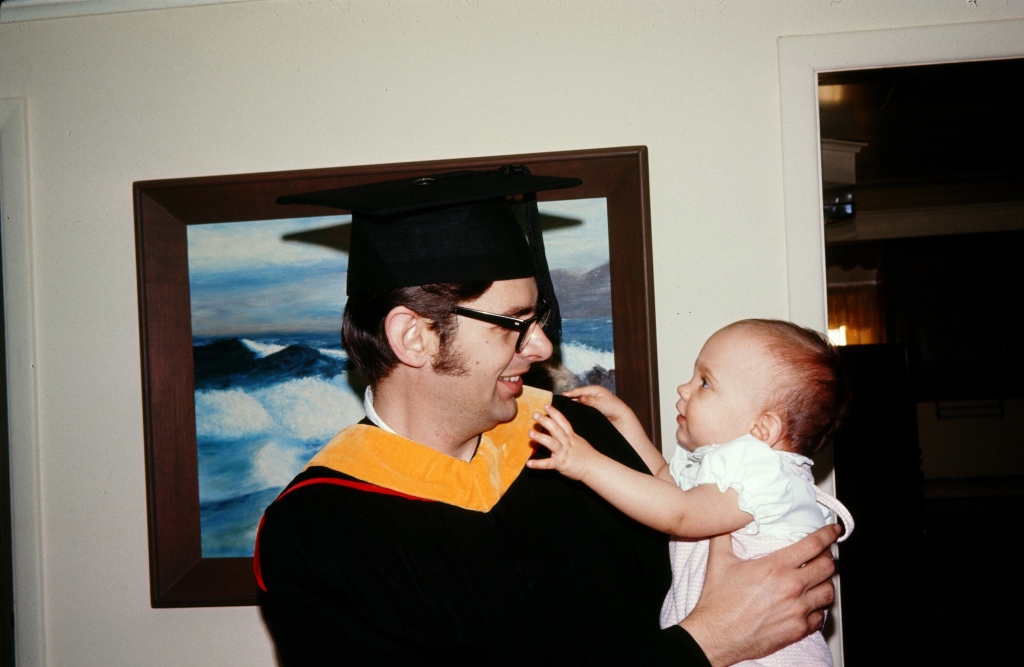
I graduated in 1971 with degree for Chemical Engineering. My Mom and Dad didn’t attend my college commencement. I don’t know why. I never asked. It never came up.
So long, good luck and have a nice day…
 Long Story Short: A Collection of Stories by Hal Gunardson